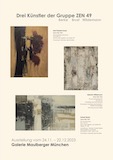
Cavael, who studied at the Städel school in Frankfurt starting
in 1924, initially earned his living doing work for the film
industry as an advertising graphic artist and instructor for
applied graphic arts. His first exhibit in the year 1933 in
Braunschweig, which he conducted together with Josef Albers,
was the event that prompted the National Socialists to
prohibit him from painting.
As a pioneer of the abstract, Cavael strongly supported the
theoretical post-war controversy concerning the polarisation
of abstract and objective art. Together with Gerhard Fietz,
Rupprecht Geiger, Willy Hempel, Brigitte Meier-Denninghof
and Fritz Winter, Rolf Cavael founded one of the most
significant artists' groups after 1945, the Group ZEN 49
in Munich, under the patronage of Willi Baumeister.
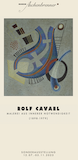
One motivational force behind Cavael's work is his fascination
for microbiology and his study of the laws of nature. In fact,
his "floating forms" of the early 1950's are indeed
reminiscent of cells seen through a microscope, compact
geometrical forms which seem to develop lives of their own
and correspond against monochrome-coloured backgrounds.
The effect of the precision and static tranquillity of
this phase of his work gave way to strongly gestic works
full of dynamics in the 1960's and 1970's. Scrutiny of
these works reveals Cavael's affinity to music.
Compositions took shape in which Cavael, using the
means of painting, found an "inner sound",
comparable to Kandinsky. In comparison to Jackson
Pollock's drip paintings, in whose lineal
labyrinths the line is reduced to a product of coincidence,
Cavael's lines become increasingly independent and advance to
the most important means of expression. Colour plays a
contrapuntal role, allowing whirlpools of lines to swell to
brilliant crescendi or pitting against the staccati and the
fermate, suggested by the brush.